Every borehole tells a different story.
GeoView reconstructs the thermal response of the subsurface using lithological and hydrogeological information from each borehole. This individual characterisation complements experimental thermal response testing (TRT) and helps explain variations within the same geothermal borehole field.
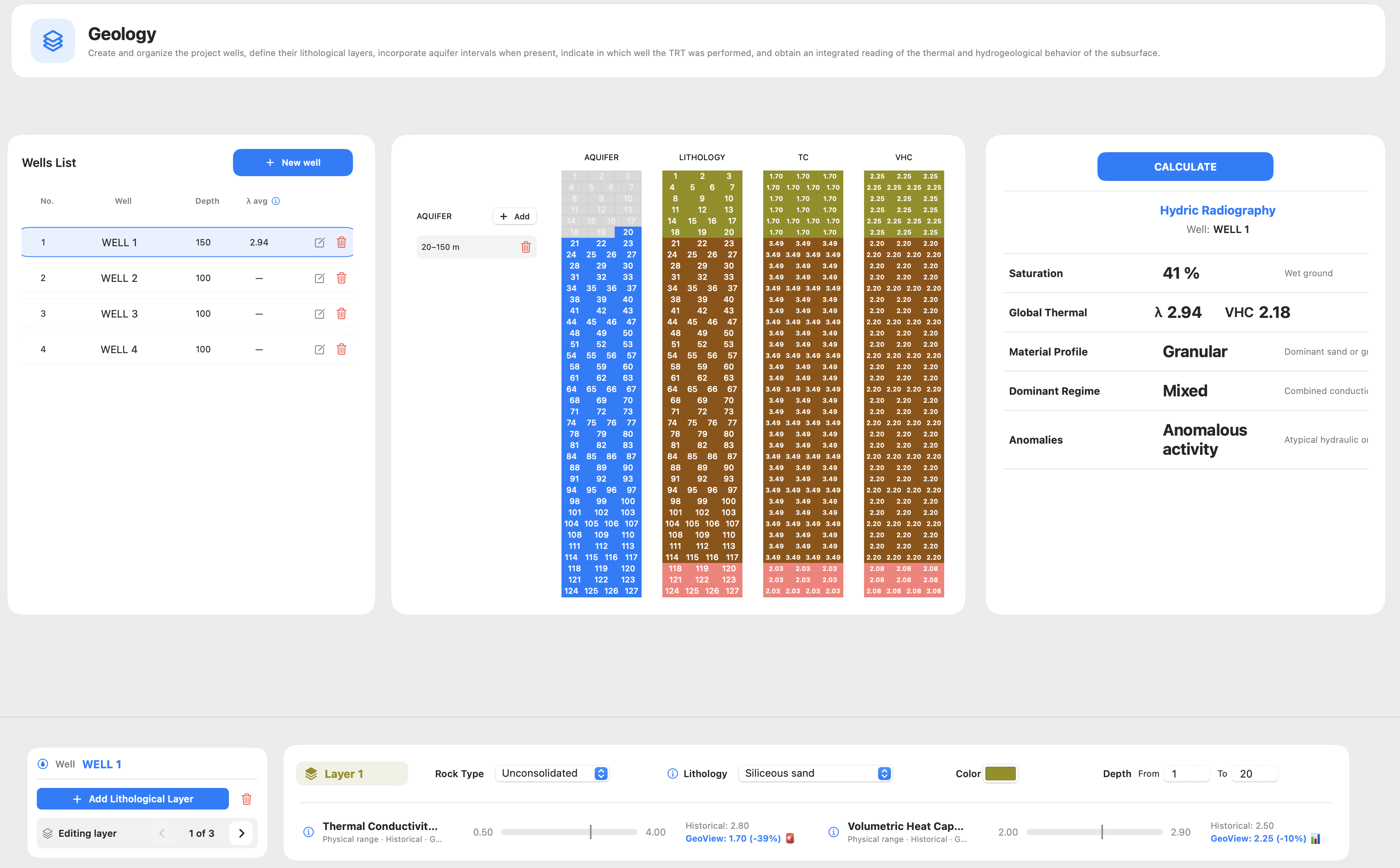
Each borehole provides unique information about the subsurface. Even within the same geothermal field, geological layers and hydrogeological conditions may vary from one borehole to another. GeoView characterises each borehole individually using its lithological profile and integrating the thermal properties of the materials, groundwater presence and flow, and heat-transfer mechanisms. The result is a reconstruction of the ground's thermal behaviour at depth, revealing the contribution of different layers beyond a single average thermal conductivity value.
The thermal response test (TRT) remains an essential experimental reference. GeoView is intended to complement it, not replace it. Geological and hydrogeological information makes it possible to develop an independent estimate and compare it with the measured test result. The TRT thus provides an experimental benchmark, while individual characterisation helps assess how representative that result is of the other boreholes in the geothermal field.
GeoView's real value lies not merely in approximating a TRT result, but in understanding the thermal behaviour of the subsurface. Its methodology has been compared with approximately 50 real thermal response tests, showing deviations below 15% and, in some cases, below 5%. These comparisons support a characterisation approach that goes beyond numerical agreement: what matters is not only how closely GeoView matches a test result, but also its ability to provide a physical explanation of the ground's thermal response.
Why does a better understanding of the subsurface matter? Among other applications, it helps assess whether a geothermal field can be designed with a more efficient borehole layout. Not every metre drilled necessarily delivers the same thermal value: its contribution depends on the geology encountered, depth, borehole position and interactions across the field. This is the principle of Useful Metre. More detailed characterisation supports decisions about borehole length, number and distribution, and helps identify opportunities to avoid unnecessary drilling where project conditions allow. The aim is not to drill less at any cost, but to determine whether the same thermal performance can be achieved through a more efficient solution with lower drilling investment.