What do we really know about the subsurface of the Moon and Mars?
Before exchanging heat with another world, we need to understand it. What temperatures, thermal conductivities and other thermal properties would we encounter at different depths?
GEOVIEW LABS / MOON & MARS
At GeoView, we work to understand the subsurface of our planet and explore how to use its energy responsibly.
But some questions take us much further.
What if one day we could use the subsurface of the Moon or Mars to help heat and cool the habitats of the future?
Could we store heat beneath the lunar surface? What possibilities might Martian rocks offer? How would our geothermal models change on worlds so different from our own?
Today, we do not have those answers.
And that is precisely why we want to explore them.
GeoView Labs was born as a small space for curiosity, exploration and difficult questions. A place where imagination opens the door and physics determines how far we can go.
Because before we can build the future, someone must dare to imagine it.
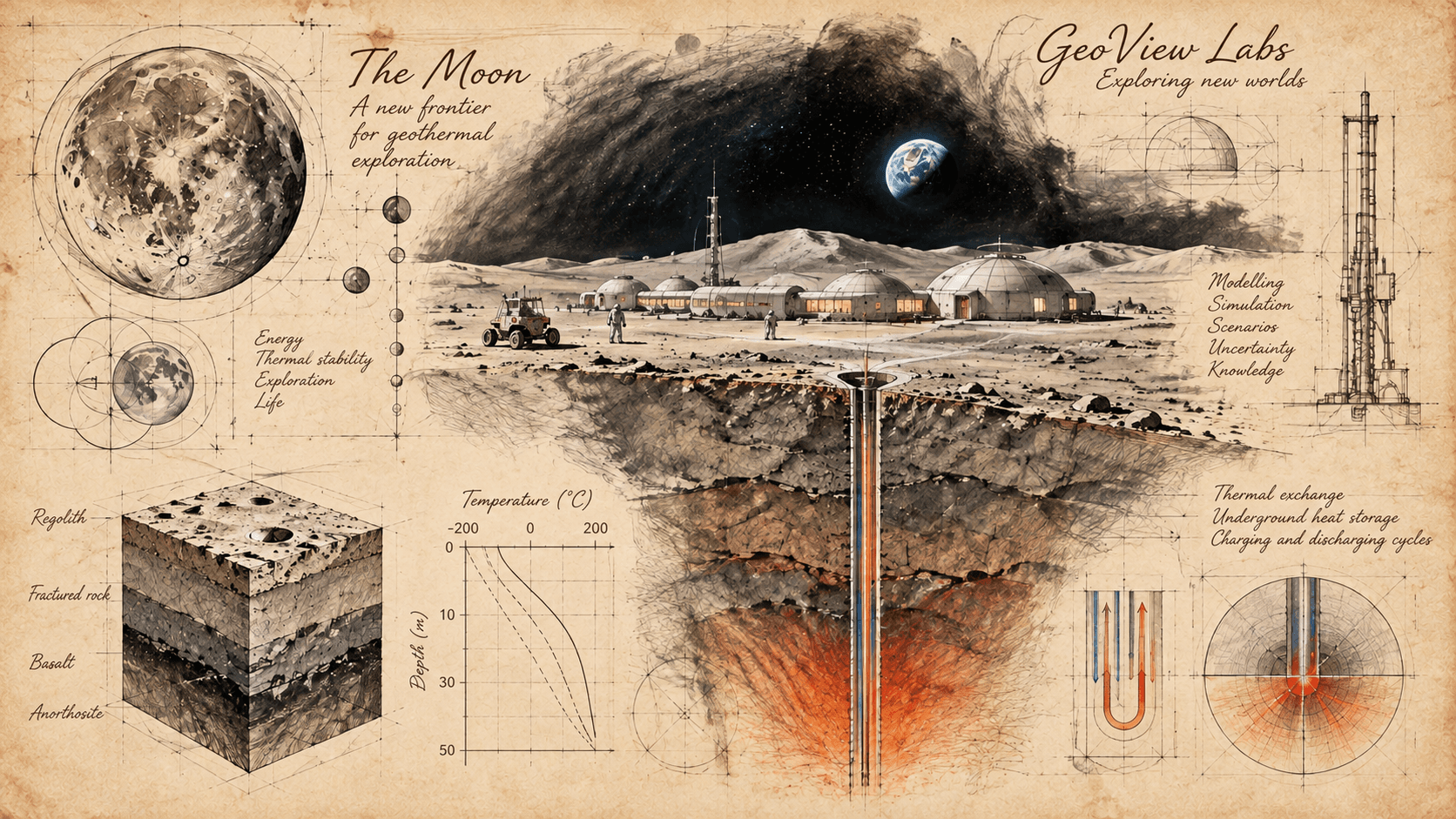
GEOVIEW LABS / OPEN QUESTIONS
Before exchanging heat with another world, we need to understand it. What temperatures, thermal conductivities and other thermal properties would we encounter at different depths?
During the long lunar day, solar energy is available. Could we capture it, store it beneath the surface and recover it during approximately two weeks of darkness?
Lunar regolith has low thermal conductivity. Could alternative geometries, materials or heat-exchange systems compensate for this limitation?
Extreme temperatures complicate fluid selection. How could we balance freezing risk, viscosity, heat capacity and pumping energy? Could alternatives to conventional circulation loops exist?
Low gravity, abrasive dust and the difficulty of maintaining machinery change the rules. Would vertical borehole heat exchangers make sense, or should we consider other installation methods?
Every kilogram launched into space matters. Which components would we transport, which could we manufacture locally, and how would that change the design of our systems?
Pipes, seals, insulation and connections would need to withstand thermal cycling, vacuum or unfamiliar atmospheres, and potential mechanical damage. Which materials would we choose, and how could we verify their durability?
Before sizing a heat exchanger, we would need to understand heating, cooling and storage requirements. How would the energy balance differ between the Moon and Mars?
A system operating millions of kilometres away would need to detect faults, adapt to thermal changes and continue working with minimal maintenance. How could we design that level of autonomy?
On a world with virtually no atmosphere, extreme temperatures and limited resources, how could we design a heat pump capable of heating and cooling a habitat? What would need to change compared with the systems we use on Earth?
Drilling, pumping or storing heat might consume more resources than they save. How could models and simulations help us find out before building anything?
· · ·